
Infoport or booth? What and how to choose >
Infoport or translation booth? What and how to choose?
Choosing a system for simultaneous translation is one of the key decisions when organizing a multilingual event. The two most popular options are the classic interpretation booth and mobile infoports (tour guide systems). Both allow for real-time interpretation, but differ significantly in terms of logistics, costs, interpreter's comfort, and flexibility.
Below you will find a practical comparison and tips that will help you make the right choice.
What are the differences between these two solutions?
Interpretation booth
This is a soundproof workstation where a pair of interpreters work. It provides acoustic insulation, professional working conditions, and the highest sound quality. It requires transportation, setup, power supply, and the presence of a technician. One booth is required for each language combination you plan to have at your event. e.g. Polish<==>English and Polish<==>German requires two booths.
Infoports (tour guide system)
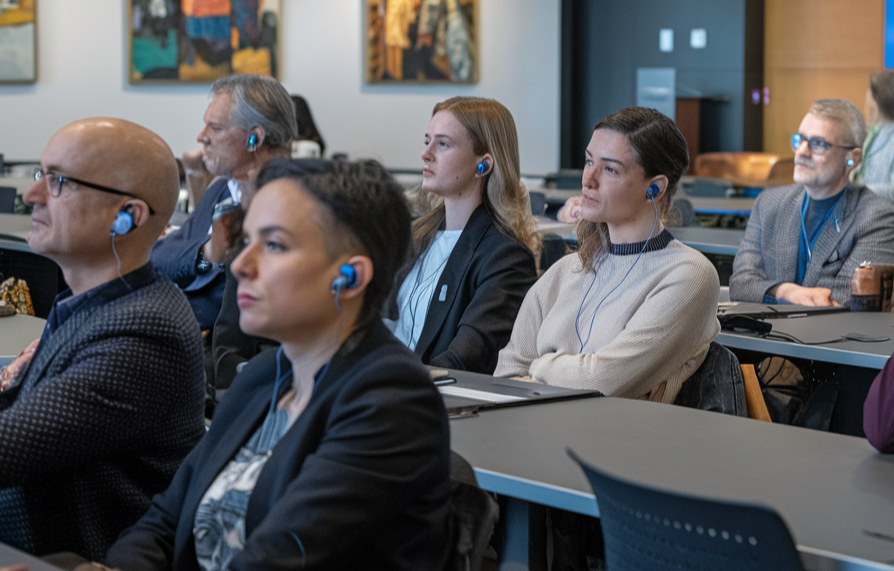
These are lightweight, wireless sets consisting of transmitters and receivers with headsets. The interpreter speaks into a microphone, and participants listen through individual receivers. The system is mobile, quick to set up, and does not require complicated infrastructure. In some cases a half-booth or sound insulators (like a desk in an open space office) can be used, bu the main feature is mobility.
Comparison of key parameters
| Criteria |
Infoports |
Translation booth |
||
|---|---|---|---|---|
|
Mobility |
Very high - participants and translators can move around |
|
Low - the system is stationary |
|
| Installation time and cost | Low - often just a suitcase with the set is enough | High - transportation, setup, dismantling | ||
| Sound quality | Good (telephone conversation level) | Very high (conference quality) | ||
| Translator working comfort |
Lower - the translator is visible, less support |
High - insulation, ability to work in pairs |
||
| Number of languages | Practically limited (noise with multiple channels) | Large - easy to work with multiple booths and relay | ||
| Event duration | Best up to 3 - 4 hours |
Works well for longer events | ||
| Budget | Usually 40 - 50% lower | Higher | ||
| Technical requirements | Minimal | Full technical support | ||
| Confidentiality | Depends on the technology (RF has limitations) | Easier to ensure |
When to choose infoports?
Infoports work best when:
- The group needs to move around (audit on a factory floor, study visit, walk through a facility, outdoor training).
- The event takes place in an unusual location (garden, hall, outdoor, museum).
- You require a quick setup, minimal tech staff and you require to minimise the costs.
- The number of language pairs is limited (usually 1- 2).
- The event is not very long (3 - 4 hrs maximum).
- You want to avoid complicated booth installation.
This solution is particularly popular for hybrid events in unusual spaces, town halls with moving audiences, and small to medium groups that are either mobile or in a fixed location.
When is the booth a better choice?
An interpretation booth is recommended when:
- The event is stationary and formal (large conference, general meeting, expert panel).
- You need the highest sound quality and a professional image and the event has a PA system.
- You need to record, stream or broadcast the event.
- You plan to translate into more than one language and use the relay method.
- The event lasts longer than 3 - 4 hours (better working conditions for interpreters).
- The content is confidential or requires a high level of security.
- There is a fixed seating arrangement for participants and no need for mobility.
- There are other sources of sound/noise in the room, e.g., a band is playing or people are working in subgroups.
Key decision-making questions
Ask yourself these questions before choosing a system:
- Will participants be moving from place to place during the event?
- How many languages will be translated simultaneously?
- How long will the event last?
- What level of sound quality and professional reception (for recording or broadcast) is required?
- What is your budget and logistical capacity?
- Is the content sensitive or confidential?
- Will interpreters work on-site or remotely?
If mobility and simplicity are priorities - infoports will be the natural choice.
If you prioritize the highest quality, long-term work, and a formal nature - it's better to opt for a booth.
Summary
There is no universally better solution. Infoports provide freedom, speed, and lower cost but have limitations in sound quality, interpreter comfort, and number of languages. The booth offers the highest standard but requires greater organizational and financial investments.
The best decision is always made based on the specific event scenario, not general preferences.
Not sure which solution will be better for your event?
Contact us – we will analyze the scenario and advise on the optimal configuration (infoports, booth, or hybrid solution). You can also use our decision tool "booth or infoports?", where you will answer a few simple questions, and the system will suggest which solution is more suitable. You can send us the result via email, and we will contact you after analyzing your needs.
Contact us at:
t: +48 502 386 666
@: biuro@oiww.eu



OIWW sp z o.o.
ul. Twarda 18
00-105 Warsaw
@: biuro@oiww.eu
t: +48 502 386 666
Copyright OIWW sp z o.o. 2026